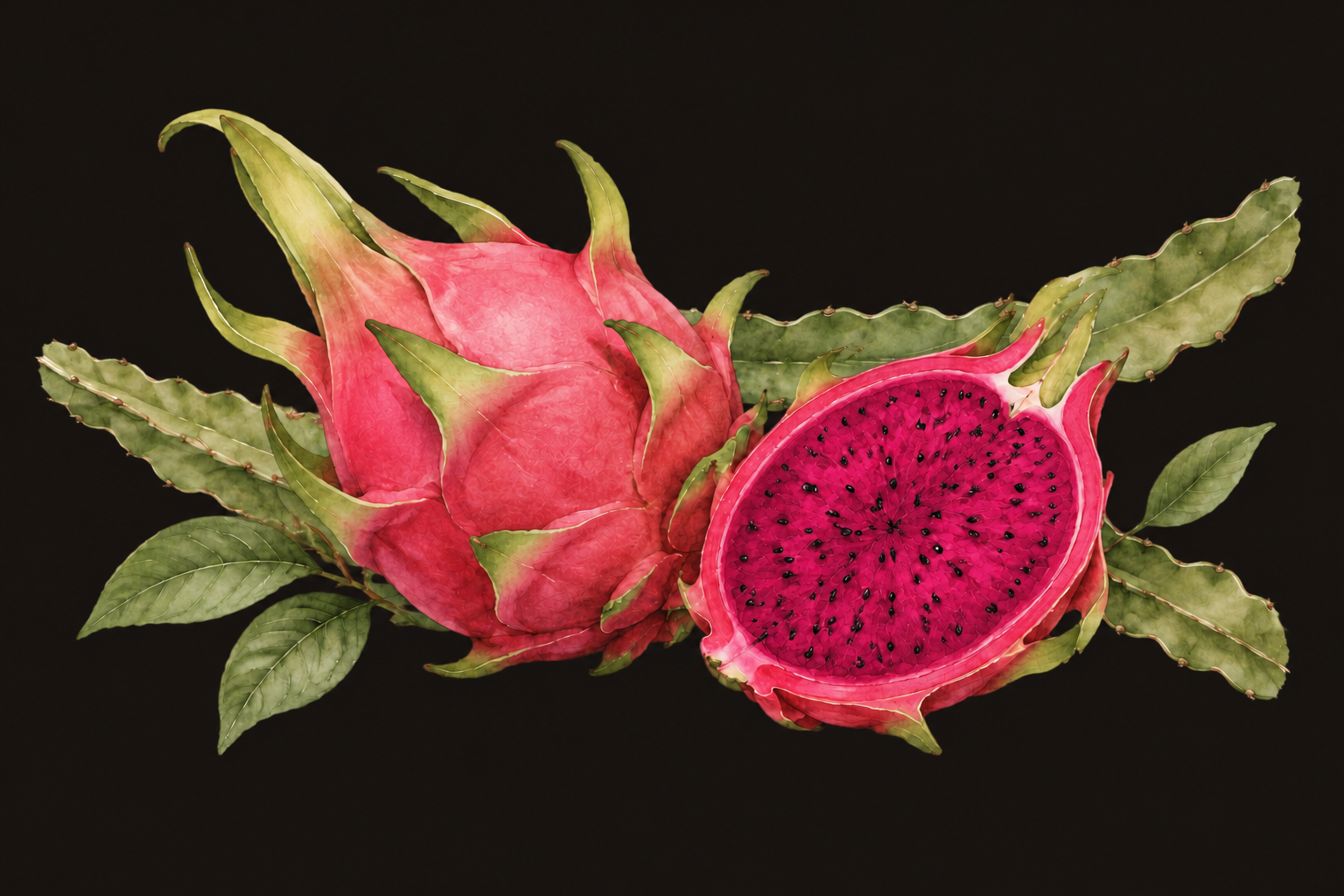
Inside the fruit, per 100 grams of fresh flesh
- Energy
- 68 kcal
- Water
- 82.4 g
- Carbohydrates
- 16.2 g
- Fiber
- 1.8 g
- Protein
- 0.68 g
- Fat
- 0.21 g
- Vitamin C
- 19.8 mg
- Potassium
- 206 mg
- Magnesium
- 14 mg
- Iron
- 0.12 mg
Source: USDA FoodData Central, the official database of the United States Department of Agriculture, "Dragon fruit" entry (FNDDS no. 2709234).
These are average values: they change with the species, the variety, the soil and the ripeness. For vitamin C, for example, published measurements range from about 3 mg to almost 20 mg per 100 g.
What about the science?
Studies on pitaya are still few, and small. Some were done on people, but with few participants; many of the properties you read around come only from test tubes or animal studies.
In Europe, no health claim is authorised for this fruit.
That is why we promise no effects here: we only tell what is really known.
The data source
Composition: USDA FoodData Central, "Dragon fruit" entry, FNDDS no. 2709234 (official US data, consulted on 16 October 2026).